Relieving & Joining of Officers on Hardship Transfer 2026 Complete Guide
 Follow YourSiteName on Google News & scroll through your favourite content faster!

Transfers in government service are never easy—especially when they happen on hardship grounds. For many officers, these transfers come after long personal, medical, or family struggles. That’s why the Relieving & Joining of Officers on Hardship Transfer 2026 Notification issued by the Directorate of Education Colleges, Lahore Division is so important.
 Join WhatsApp
This blog explains the notification, so principals, officers, and staff can understand what is required, why it matters, and what happens if instructions are ignored. If you or your colleagues are affected by hardship transfers in 2026, this guide is for you.

Punjab Officers Hardship Transfers Strict Orders 2026
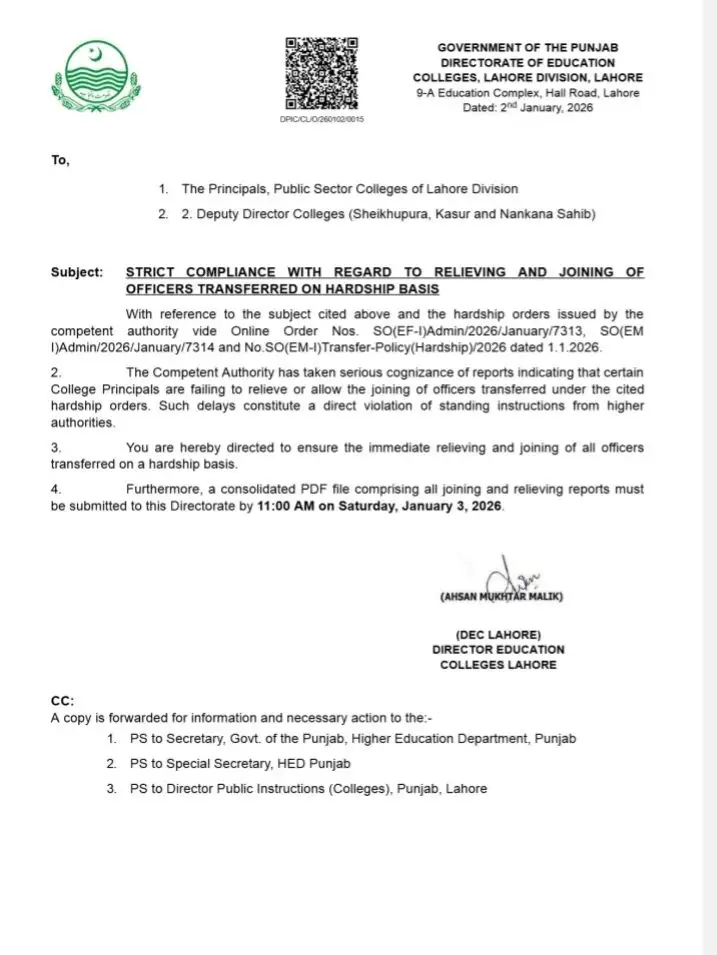
On 2nd January 2026, the Government of the Punjab – Directorate of Education Colleges, Lahore Division issued a strict compliance notification addressed to:
- Principals of public sector colleges in Lahore Division
- Deputy Directors Colleges of Sheikhupura, Kasur, and Nankana Sahib
The reason?
Repeated complaints showed that some principals were delaying or blocking the relieving and joining of officers transferred on hardship basis—despite clear orders from higher authorities.

The department decided enough was enough.
What Is a Hardship Transfer?
A hardship transfer is granted when an officer faces serious personal difficulties, such as:
- Medical issues (self or dependent family members)
- Disability-related challenges
- Widowhood or family care responsibilities
- Extreme distance or unsafe postings
- Other genuine humanitarian reasons
These transfers are approved by competent authority and are not optional or negotiable at college level.

Reference Orders Mentioned in the Notification
The January 2026 notification refers to the following official hardship transfer orders:
- SO(EF-1)Admin/2026/January/7313
- SO(EM-1)Admin/2026/January/7314
- SO(EM-I)Transfer-Policy (Hardship)/2026
- All dated 1st January 2026
These orders are legally binding and must be implemented immediately.
Key Instructions Issued by the Directorate
The notification contains very clear and firm directions. Let’s break them down:

-
Immediate Relieving of Officers
- Principals must relieve officers without delay
- Personal preferences or administrative excuses are not acceptable
-
Immediate Joining at New Posting
- Receiving colleges must allow officers to join immediately
- No unnecessary paperwork delays
-
Zero Tolerance for Non-Compliance
- The authority has taken serious cognizance of delays
- Such actions are considered a violation of standing instructions
-
Submission of Consolidated Reports
- All colleges must prepare:
- Joining reports
- Relieving reports
- These must be merged into one consolidated PDF file
-
Strict Deadline
- The consolidated PDF must reach the Directorate by:
11:00 AM, Saturday, 3rd January 2026
No extensions. No excuses.
Why This Notification Is a Big Deal
This isn’t just another routine circular. It sends a strong message:
- Hardship cases are human issues, not clerical files
- Delays can worsen medical, family, and mental stress
- Authority will now hold principals accountable
In short:
👉 “Relieve them. Let them join. Do it now.”
Responsibilities of College Principals
Principals must now ensure:
- Timely issuance of relieving orders
- Proper documentation without harassment
- Respectful handling of hardship cases
- On-time reporting to Directorate
Failure to comply can invite disciplinary action under service rules.
What Transferred Officers Should Do
If you’re transferred on hardship basis:
- Keep copies of your transfer order
- Report to the new college immediately
- Request written joining report
- Follow up politely but firmly
- Inform Deputy Director if delays continue
Your transfer is your right, not a favor.
Common Mistakes to Avoid
- ❌ Holding officers due to staff shortage
- ❌ Asking officers to “wait a few days”
- ❌ Sending incomplete reports
- ❌ Missing the submission deadline
- ❌ Treating hardship transfers like routine moves
Remember: Delay = Disobedience.
Frequently Asked Questions (FAQs)
- Are hardship transfer orders mandatory?
Yes. They must be implemented immediately without delay.
- Can a principal refuse to relieve an officer?
No. Refusal is a violation of higher authority instructions.
- What happens if reports are not submitted on time?
The principal or concerned officer may face administrative action.
- Is this notification applicable outside Lahore Division?
This specific order applies to Lahore Division, but the principle applies province-wide.
- Can officers complain if joining is delayed?
Yes. Officers can report delays to Deputy Director or Directorate.
Final Conclusion
The Relieving & Joining of Officers on Hardship Transfer 2026 Notification is a strong reminder that rules exist to protect people, not paperwork. By enforcing immediate compliance, the Punjab Higher Education Department has taken a clear stand for fairness, empathy, and discipline. When hardship transfers are respected and implemented on time, the system works better—and so do the people within it.